Mostrando entradas con la etiqueta Horror. Mostrar todas las entradas

domingo, 16 de agosto de 2026

Preview of Odin, by James Tynion IV, Marguerite Bennett, Letizia Cadonici and Jordie Bellaire


James Tynion IV is, without a doubt, one of the most successful comic book writers today. Series like Something is Killing the Children, The Department of Truth, and The Nice House on the Lake are among the most acclaimed titles by fans in the last decade. So, any new work of his raises massive expectations. That is why, when I had the opportunity to request a review copy of Odin (co-written with Marguerite Bennett, with art by Letizia Cadonici and colors by Jordie Bellaire), I couldn't resist. What I didn't imagine (because it wasn't specified anywhere) was that it was only a preview of thirty-something pages (corresponding, I believe, to the first issue of the series), which has left me a bit wanting more.

Odin is the story of a group of neo-Nazis who plan to summon a Norse god deep in the wilderness of Norway. It is also the story of Adela, a journalist who infiltrates the group with the goal of writing an exclusive story. And, of course, it is the story of how things do not go as expected, and misfortunes and tragedies begin to happen left and right.

And, as they used to say on a popular TVE show many years ago... that's as far as I can read. Because, precisely, that is as far as I was able to read with the preview I was given, from which I haven't been able to draw many conclusions. Is it an interesting story? Yes, undoubtedly. Would I keep reading it? Absolutely! Can I recommend it? Well, I don't know, because I've only been able to taste a tiny fraction of it. But things are looking good.

And speaking of looking good, the artwork is more than adequate without being particularly spectacular. Cadonici more than delivers and is aided, of course, by the always perfect colors of Bellaire. Nothing to object to in that department.

There is little more I can add. It is a work that seems to be very much in line with everything Tynion produces, and I will be delighted to read it in its entirety when it becomes available. In the meantime, it's time to wait.

lunes, 7 de noviembre de 2016

Review of novellas by Khaw, Penny and Williams


(Disclaimer: English is my second language, so I want to apologize in advance for there may be mistakes in the text below. If you find any, please let me know so that I can correct it. I'd really appreciate it. Thanks.)

Review Soundtrack: I suggest reading this review while listening to The Future Never Dies, by Scorpions (Spotify, YouTube). 

In this new instalment of novella reviews, today I bring you the three most recent ones published by Tor.com: Hammers on Bone, by Cassandra Khaw, Everything Belongs to the Future, by Laurie Penny, and Impersonations, by Walter Jon Williams.  

The first of them, Hammers on Bone, is yet another Lovecraftian pastiche, on this occasion in the form of a classical noir story. As I mentioned when I reviewed The Dream-Quest of Vellitt Boe, by Kij Johnson, I am not really into Lovecraft and I didn't care much for that part of the novella. However, I did like how Khaw managed, from the very first sentence, to evoke an appealing atmosphere, well in the tradition of crime fiction, but with some innovative elements. 

The protagonist, John Persons, is also very interesting and his mysterious back story is only partially revealed in Hammers on Bone. Thus, if at it seems, this is just the first part of a series of novellas, I think there are enough elements to make the next instalment even better. I, for one, will be reading it. 

Everything Belongs to the Future is a very intelligent science fiction story that brings together medical, economical and social speculation in an almost perfect way. The beginning is really strong, and the idea of an eternal life medicine that can only be afforded by the well-off is, at the same time, plausible, scary and thought-provoking. 

I did also like the way Penny recreates the group dynamics and personal relationships of the activists. Again, really believable and provocative, especially because we are given some information that most of the characters don't know. I found some pacing problems after the first half of the story, but apart from that, I thoroughly enjoyed the novella and I recommend it. 

Impersonations, by Walter Jon Williams, is another science fiction novella, in fact one set in the universe of his Praxis novels. I didn't know when I started reading it and, when I realized, I was a bit afraid I wouldn't be able to follow the story or I would miss some important information, but I am happy to say that it is a stand-alone and can be enjoyed without any previous knowledge of the series. 

In fact, after reading Impersonations, I may give the rest of the Praxis stories a try, for I really liked the setting, with lots of political intrigue and, above all, the really interesting main protagonist, Caroline Sula, who strongly reminded me of another favorite of mine: Adam-Troy Castro's Andrea Cort. On the negative side, there were some coincidences that were too convenient for the plot to advance by the end of the book, but all in all, I really liked the novella and I'd recommend it to any science fiction fan. 

So, again, another three solid novellas from Tor.com. I did especially enjoy the two science fiction ones (Everything Belongs to the Future and Impersonations), but I guess you'll also like Hammers on Bone if Lovecraft is your thing. As always, my advice is to keep a close eye on anything published by Tor.com for they hardly disappoint. In fact, I have just finished reading the Lychford stories by Paul Cornell and they are really refreshing and entertaining. I will review them in detail later this month, so stay tuned!

(You can also read this review in Spanish/También puedes leer esta reseña en español)     

viernes, 9 de septiembre de 2016

Reviews of novellas by Powers, Haley, Palecek and Olson


(Disclaimer: English is my second language, so I want to apologize in advance for there may be mistakes in the text below. If you find any, please let me know so that I can correct it. I'd really appreciate it. Thanks.)

Review Soundtrack: I suggest reading this review while listening to Goodbye Horses, by Q Lazzarus (Spotify, YouTube).

It's been a while since I last devoted a post to reviewing novellas. But it doesn't mean that I have not been reading any. On the contrary, I have so many I want to talk about that I will reviewing four today and another three later this month. Are you ready?

My first selection is also the one that was the most disappointing: Down and Out in Purgatory, by Tim Powers. I had great expectations with this novella and I am afraid that I can't recommend it. The start was quite interesting and I did really like things like the topology of Purgatory and the way the dead communicate with the living. But after that, the plot seems to stop making that much sense and I quickly lost all my interest in finding out what was going to happen to the protagonist. As I mentioned, quite a disappointment. 
  
I did like The Ghoul King, by Guy Haley, much more. This is the second instalment of the Dreaming Cities series, whose first volume, The Emperor's Railroad, I reviewed earlier this year. In that occasion, I said that I wanted to wait to read the sequel because I was really intrigued by the final part of the novella. And I must say that the potential of the story is beginning to explode fully in this second part. The plot has definitely changed for the better, with new science fiction elements that makes it more interesting and original. The next novella has not been announced yet, but it is one that I will surely be reading as soon as I can get it. 

City of Wolves, by Willow Palecek, has an interesting worldbuilding and shows a lot of promise if, as it seems, this is just the first instalment in a series. Roughly speaking, the novella is a detective story in a world where werevolves are real. Alexander Drake must investigate a strange murder in what constitutes a fairly intriguing and interesting story. However, the writing is a bit bland, with a worldbuilding that is too schematic and a somewhat thin atmosphere. City of Wolves is entertaining enough, but it does not fully realize the potential of the ideas and the characters. I hope there is a sequel in which these problems are taken into account. 

Finally, Nightshades by Melissa F. Olson, is the novella that I enjoyed the most of the four I am writing about today, and one that I highly recommend. It is similar to City of Wolves in that it is also a detective story with supernatural elements, but Olson's prose and tone worked much better for than Palecek's. Nightshades can be briefly described as Silence of the Lambs with vampires, and, in fact, the author clearly acknowledges that influence early in the story. The novella is far from perfect (in fact, I is a bit of a guilty pleasure somehow), but it kept me reading page after page and I am really looking forward to the next in the series. 

All in all, of these four novellas I highly recommend Nightshades and you will want to check The Ghoul King if you liked The Emperor's Railroad. I'd also keep an eye on Palecek's work, for it shows potential and, sadly, I'd recommend giving Down and Out in Purgatory a pass. Oh, and stay tuned in: more reviews of novellas coming soon!

(You can also read this review in Spanish/También puedes leer esta reseña en español)         

viernes, 29 de julio de 2016

Félix García interviews Nathan Ballingrud

Félix García is back with us with another of his amazing interviews. In this case, he talks with Nathan Ballingrud whose short story collection, Ecce Monstrum, has been recently published in Spanish by Fata Libelli. Hope you enjoy the interview and notice that you can read a translation into Spanish at Fata Libelli's website.  

Félix García: Let’s begin assuming you, as many of contemporary readers and writers, have been attracted to literary horror by the boom that this genre had in the 70’s and 80’s (S. King, P. Straub, etc.) Nevertheless, many of you have ended up in a literature very different from these formative models. Which are the main differences between that so called golden age and this one that we could label as weird renaissance?

Nathan Ballingrud: That’s an interesting question, and one I’m not sure I have the right perspective to answer. I suspect people a generation from now will be better able to say. That being said, the writers of today have the advantage of drawing from the imaginations of those that have come before. Whereas they wrote in response to the generation which preceded them, we write in response to their own work. We’re just the latest iteration in a long conversation.

FG: As far as I know, your first stories started appearing in magazines and anthologies, kicking ass as Athenea from Zeus skull, that is, without any noticeable learning period. And this, after what I fancy to imagine as a lairdbarronesque life, working as waiter in New Orleans and cook in offshore oil rigs. How do you come to writing in that time of your life?

NB: Like many writers, I knew I wanted to do this since I was a kid. I definitely had an apprenticeship period; it’s just that I chose not to submit most of those stories for publication, and I was fortunate enough that those I did submit were mostly rejected. So though it might seem like it happened all at once, it took many years. I’m grateful, in a way, that there were less avenues into print when I was in my twenties. I’d not like to be dragging those stories behind me today. I learned that fairly early on, too; I knew I wasn’t writing the kind of thing I felt like I’d eventually be capable of, so I chose to work the kinds of jobs, and live in the kinds of places, that would put me into contact with different perspectives on the world. At some point in my early thirties, without even really thinking about it, I felt ready, and I started writing again. I think it’s extremely important for writers not to get too isolated from the world around them. You have to keep in touch with the world. That’s much more important than keeping current with the latest trends in literature.

FG: Focusing now in North America Lake Monsters, the collection Ecce Monstrum stories are taken from, I notice a clear will of drawing up the classic horror tropes but for the significant exception of the lovecraftian pantheon. Explain to us, please, this abhorrence to tentacles.

NB: I don’t abhor tentacles at all. I get great joy from reading Lovecraft, and other kinds of cosmic horror. But it doesn’t reflect what’s inside of me: my own fears or anxieties or obsessions. I don’t care about humanity’s insignificance; in fact, I find comfort in it. To write effectively -- whether or not you’re writing horror -- I think it’s important that you write about whatever unsettles you, or nags at your spirit, or puts a thorn in your heart. For me, it almost always comes down to the misunderstandings in close relationships, or the way love can lead you down strange avenues, sometimes to your peril. The classic tropes of horror fiction have always held great appeal to me; I think they’re still powerful symbols, if properly used. Part of the fun of using them is rediscovering what made them terrifying to begin with. They can be wonderful tools for magnifying a variety of themes.

FG: Your stories bring up characters living crucial moments, just in the act of making the decisions that determine them to the reader and themselves. In this sense, comparisons with Raymond Carver are justified, although in your stories that crucial moments usually include some supernatural or monstrous element that catalyzes the conflict. When it comes to build these characters, do you turn to observation, to your own personal experiences or established archetypes?

NB: I avoid archetypes with characters whenever possible. Archetypes can work well for the monsters, but you have to be mindful of how you’re using them, to avoid falling into cliche. For my characters I rely on both observation and personal experience. There’s a lot of both in North American Lake Monsters. A lot of myself, a lot of what I fear I might be, and a lot of what I see in the people around me. Writers should be observers of the human drama, which means more listening than speaking. Writers should do their talking on the page.

FG: I’m asking the same thing about the places. In a recent debate, Scott Nicolay emphasized very eloquently the need to use places you are familiar with, and it’s obviously a successful method for him. Does it also work for you?

NB: It does. Most of my stories have been set in New Orleans and the southern Appalachians, two places I’m very familiar with. Atmosphere is vital to horror and dark fiction, and setting is often the bedrock for atmosphere. Familiarity allows you to access elements of setting that will not be available to those who haven’t experience it first-hand: the smell, the air pressure, the hidden pockets. I wouldn’t go so far as to call that kind of familiarity a need, but it’s certainly a boon. 

FG: In the last years we have watched some “indie” horror films as It Follows (2014) or The Babadook (2014) that resonate deeply with what’s going on in the literary field, although it seems that Hollywood blockbusters go against the tide. How do you see the mutual influence between horror literature and horror film?

NB: I’m not sure I agree that those movies resonate much with what’s going in the current literary field. I think they resonate with the writers, because they’re terrific films, but they seem more engaged with the tropes of other, older horror films than they do with the current literary scene. The new Netflix series Stranger Things is another example of this; it engages with the horror tropes of the 80s -- King and Spielberg, most obviously -- and arguably not at all with anything from the new century. I think this is typical. Writers are often much more directly influenced by movies than vice versa. No doubt this is due to the nature of the movie making business, which tends to proceed glacially and with extraordinary timidity. Thankfully, there are signs that the filmmaking world is starting to notice what’s happening on this side of the fence, with forthcoming movies based on works by Jeff VanderMeer and Laird Barron. Others, no doubt, are percolating behind the scenes.

FG: If I were to judge by your recent works (I’m thinking now of “The atlas of Hell”), a clear influence of contemporary comic book -in the line of Vertigo or Image- can be noticed, which translates in that a growing focus on the plot without detriment of weird atmospherics. To me, this relates you even more to classic pulp. Can you talk to us about this topic and say if we can wait similar things in your future works?

NB: Oh, definitely. I love comic books, and I love pulp fiction. I think some of the most interesting writers today are working in comics -- Mike Mignola, Emily Carroll, and Matt Fraction, to name a very few. I love the wild inventiveness, the unapologetic striving for entertainment value, the pursuit of joy. None of this works at cross-purposes to the atmosphere, weird or otherwise. On the contrary, pulp and atmosphere are natural cousins. More challenging is avoiding cliche. Part of the appeal of pulp fiction has traditionally been its reliance on predictable settings or outcomes, functioning as a kind of literary comfort food. When working with these trappings, I try to subvert those expectations. As in earlier stories like “Wild Acre” and “The Good Husband”, I try to use genre trappings -- in this case, pulp or comic book trappings -- to tell different kinds of stories, which might lead to unexpected endings. I’ve been having a lot of fun pursuing this new avenue.

FG: In Spain we have a settled bias against short fiction. Press houses consider collections and anthologies as poor sellers, and readers seem anxious to punish their wrists with doorstoppers the heavier the better. Nevertheless, there’s a view in the horror field, a view that dates back to Edgar Allan Poe, that short stories are the ideal vehicle for literary horror, or even, that the sensation of dread cannot be maintained through the length of a novel. As a known short story writer who is writing at least a novel (as far as I know) at the same time, where do you stand on this controversy?

NB: I think there have been novels which maintained the atmosphere of dread very successfully -- Shirley Jackson’s The Haunting of Hill House, Robert Marasco’s Burnt Offerings, Adam Nevill’s No One Gets Out Alive -- but I think it’s fair to say that successful examples are much rarer in the long form. Horror fiction relies as heavily on atmosphere as it does on character, so it really thrives in the short story to novella range. You can’t consider yourself a connoisseur of horror fiction if you’re not engaging with short fiction. Most of the true classics are found there.

FG: Finally, it has been two years from North American Lake Monsters release and what your devoted readers want to know is if there is another collection coming our way. If so, will it be only previously published material or unpublished one? Where would it be published?...

NB: Absolutely! My next collection of stories will be published soon -- probably in 2017 -- by Small Beer Press. It will be called The Atlas of Hell: Stories, and will have a lot of stories which engage with the pulp themes we’ve already talked about. Most of it will be reprints, but there should be two brand new pieces. It’ll be a lot different in tone from North American Lake Monsters, but it will have the same underlying aesthetic, so hopefully readers will come along for the ride. 

(You can also read this interview in Spanish at Fata Libelli's website/También puedes leer esta entrevista en español en la página de Fata Libelli)

miércoles, 23 de diciembre de 2015

Slade House, by David Mitchell

(Disclaimer: English is my second language, so I want to apologize in advance for there may be mistakes in the text below. If you find any, please let me know so that I can correct it. I'd really appreciate it. Thanks.)

Review Soundtrack: I suggest reading this review while listening to Novocaine for the Soul, by The Eels (Spotify, YouTube). 

I don't usually read horror, but the synopsis of Slade House (a haunted house that only appears at certain, specific dates) combined with the fact that the author was David Mitchell immediately interested me. And, in fact, I found this short novel an even more satisfying read than the longer and more complex (but also slightly disappointing) Cloud Atlas.

As expected from almost any work by Mitchell, the form of Slade House is almost as important as its content. In this case, the novel consists of five different short stories or novellas, each set nine years in the future from the previous one, each told in first person by a different narrator, and all of them linked by means of recurring characters and the presence of the mysterious house of the title. 

However, on this occasion, the structure is not so intricate as in other books by Mitchell. In fact, the plot is quite straightforward in all five novellas, making them a bit predictable after you've read a couple of them, but also transforming the experience into a kind of game in which the reader has to work up which are the elements in common between the new chapter and the preceding ones. There are also some connections to The Bone Clocks, for instance, but Slade House can be perfectly enjoyed on its own even if you've not read that other novel (as it is my case).

The strongest virtue of Slade House is, thus, how Mitchell manages to retell several times what is basically the same story, making it different every time. And this is accomplished, mainly, because the voices of the first person narrators are distinct and memorable in each and every novella. I particularly like the protagonists of the first and third ones, but all of them are extremely well-developed and completely three-dimensional. 

The book also has some minor flaws. As I mentioned above, after reading the first couple of chapters, it is fairly easy to guess some of the main twists of the plot. Also, there are some lengthy explanations in the last few stories that stroke me as unnecessary because even a not very attentive reader as myself would have understood the basic workings of the House by that point in the novel.

Anyway, I very much enjoyed reading Slade House and, what is even more important, the novel made me want to also read The Bone Clocks as soon as possible. For all these reasons, I highly recommend Slade House if you're looking for a good, solid haunted house story with charismatic and fully-fleshed characters. I'm sure you won't regret visiting Slade House.    

lunes, 11 de mayo de 2015

Collected Fiction, by Hannu Rajaniemi: Fairy Tales of the Singularity

(Disclaimer: English is my second language, so I want to apologize in advance for there may be mistakes in the text below. If you find any, please let me know so that I can correct it. I'd really appreciate it. Thanks.)

Review Soundtrack: I suggest reading this review while listening to Ain't Your Fairytale, by Sonata Arctica (Spotify, YouTube)

I consider Hannu Rajaniemi to be one of the most interesting short fiction writers currently publishing in the science fiction field. Thus, I approached his Collected Fiction with great expectations. I was looking forward both to reading the stories that I didn't know and to re-reading those that I had encountered before. I was surprised, for different reasons and in different ways, by both groups.

I had previously read stories such as "Deus Ex Homine", "The Server and the Dragon", "His Master's Voice", "Tyche and the Ants", "Invisible Planets" or "Elegy for a Young Elk" on different anthologies and magazines and over a period of several years. Now that I've had the chance of reading them one after another, I've found that they are better experienced and enjoyed as a whole, like pieces of a much bigger puzzle.

Indeed, there are many themes and ideas that are common to almost all of them and even some shared background events that lead to believe they are mostly set in the same universe or timeline. But what I appreciated the most in my re-reading them is how Rajaniemi approaches, through all of them, the topic of Singularity in a particular, original and extremely suitable way. In fact, I think that this set of stories can be aptly described as Fairy Tales of the Singularity.

The Singularity is, because of its own nature, impossible to grasp by us, puny humans. This is at least, one of the most popular and extended ways of thinking about it, especially after Vernor Vinge's foundational writings on the topic. Rajaniemi is, obviously, quite aware of the fact:
"So how are you, these days?" he asked. "Keeping busy?" 
Marja smiled. "Your wife grew up. She's a big girl now. You don't want to know how big." 
"So... you are not her, then? Who am I talking to?" 
"I am her, and I am not her. I'm a partial, but a faithful one. A translation. You wouldn't understand." ("Elegy for a Young Elk")
But that we can't fully comprehend something doesn't mean that we can't write about it. If it were so, then literature would be quite limited indeed. Do we understand love completely? Or friendship? Or beauty? Of course not, and we probably never will, but that doesn't stop us from thinking, talking, writing about them. On the contrary, it only makes it more urgent to use tools other than cold logic to explore them. Maybe we can't discuss the Singularity directly, but we can always approach it indirectly, through analogies and metaphors:
During the millennia of its journey, the darkship's mind has expanded, until it has become something that has to be explored and mapped. The treasures it contains can only be described in metaphors, brittle and misleading and distant, like mirages. ("Invisible Planets")  
Rajaniemi chooses, in most of the stories I've mentioned above, to explore the Singularity using the language and images of fairy tales:
The city was surrounded by a halo of glowing fairies, tiny winged moravecs that flitted about like humanoid fireflies and the waste heat from their overlooked bodies draped the city in an artificial twilight (...). Innumerable quickbeings shimmer in the air like living candles, and the suits of the fleshed ones are no less exotic. A woman clad in nothing but autumn leaves smiles at me. Tinker Bell clones surround the cat. ("His Master's Voice")
This approach may seem strange at first, with all the talking animals, dragons, gods, hunters that live in the woods, trolls and so on. But, in fact, once the Singularity comes, the computers will become something so above us that talking about them as if they were gods or fantastic beings could be closer to the truth than trying to describe them in terms of circuits and algorithms. Rajaniemi's writing style, with so much left unsaid and unexplained, can be a little demanding on the reader, but once you accept the rules of his game, it becomes fascinating. I dare to say that his way of dealing with the Singularity is not only one of the most original out there, but probably one of the most adequate as well.

As I mentioned above, there were also a number of stories in this collection, approximately half of the total, that I hadn't read before. I was also surprised by them, but in a not so pleasant way as with my revisiting the ones I had encountered before. Maybe my expectations were a little off, but I didn't imagine Rajaniemi wrote horror ("Ghost Dogs", "The Viper Blanket"), plain fantasy ("Satan's Typist") or folklore-inspired tales ("Fisher of Men"). Unfortunately, I was left quite cold by them and also by those stories with a more experimental edge ("Snow White Is Dead", "Unused Tomorrows and Other Stories").

Of the tales that I didn't know before I did like "The Jugaad Cathredal" (which reminded me somehow of Neal Stephenson and Charles Stross), "The Haunting of Apollo A7LB" (simple but nice story) and "Skywalker of Earth" (a little too pulpy for my taste, but with some memorable scenes). However, after the super-strong first half of the book, I couldn't help feeling a bit disappointed by these comparatively weaker stories. This is one of these cases in which less would have been more and, in my humble opinion, the collection would have benefited had some of the tales not been included.

Anyway, I recommend Collected Fiction, especially if you haven't read Rajaniemi's short fiction before. There are quite a few superb stories here ("Deus Ex Homine", "The Server and the Dragon", "His Master's Voice", "Invisible Planets" or "Elegy for a Young Elk", for instance) and the book is worth for them alone. And even if you have read them before in other places, the experience of watching them interact and form a bigger, more complete whole is very rewarding.

(You can also read this review in Spanish/También puedes leer esta reseña en español)

lunes, 30 de marzo de 2015

Harrison Squared, by Daryl Gregory


(Disclaimer: English is my second language, so I want to apologize in advance for there may be mistakes in the text below. If you find any, please let me know so that I can correct it. I'd really appreciate it. Thanks.)

Review Soundtrack: I suggest reading this review while listening to Monster by Scrimshander (Spotify).

Harrison Squared, Daryl Gregory's newest novel, is a prequel of sorts to We Are All Completely Fine (my review), his novella from 2014. And I say "of sorts" because the events told in Harrison Squared are just fiction in We Are All Completely Fine (or are they not?), just a novel about a teenager called Harrison Harrison who is not the same Harrison Harrison of the novella (or is he?). 

So, we have two books that might be linked (or not) by several characters and some unusual events and that are better read and appreciated together, but that are quite different in a lot of respects. While We Are All Completely Fine has a dark, pessimistic tone and is even a bit experimental in its form, Harrison Squared is a much more straightforward narration, lighter in mood and might be classified as YA fiction. 

In fact, one of the things I enjoyed the most about Harrison Squared is that it is full of humor. The dialog is intelligent and witty and the novel has many scenes that are really funny. Consider, for instance, the following paragraph:
Aunt Selena was unmarried, with no children of her own. Like I said, people on Dad's put off spawning as long as possible, and I figured she'd probably never swim upstream. When I was little I saw her at a few holidays, up until Infamous Last Christmas. That morning, while Mom had fought with Grandpa, Aunt Sel had asked me to bring her a glass of wine - it was nine in the morning - and when I'd delivered it she'd handed me a ten dollar bill and said, "I dislike children, but I do appreciate decent service."
Aunt Sel is just one of the many amazing secondary characters in Harrison Squared, and probably the only "normal" one. We have the amphibian Lub, the Toadmother, the Scrimshander, Prof. Waughm (go threshers!), Nurse Mandi... Despite some of them appear only a couple of times, all of them are fully fleshed (fish-fleshed, in some cases) and have a distinct and unique voice. Gregory obviously has a talent for writing unusual but lovely characters (one of the things I loved the most about the amazing Raising Stony Mayhall) and it shows. 

Another strong point of Harrison Squared is the mysterious village of Dunnsmouth, a clear homage to Lovecraft's work (the novel is full of meta-literary references). With just a few sentences, Gregory is able to set an enigmatic atmosphere, especially about the strange High School Harrison is forced to attend:
"Hello, Harrison", the students said in unison. Not just generally at the same time, but in perfect synchrony, like a choir. A choir that had been rehearsing.
I lifted a hand in greeting. They stared at me. They were dressed in blacks and grays, not quite a uniform, but definitely a look, as if hey all did their shopping at ClinicalDepression.com. My tie-dye shirt was like a loud laugh at a  funeral.  
As always, Gregory's prose is deceptively simple, making look easy what is really difficult to achieve, and setting the tone for the rest of the book with just a few, wonderful scenes. Also, he manages to mix that sense of mystery with the funny and clever dialog I mentioned above, in a seamless, natural way in which nothing is forced. Few authors are capable of sustaining that kind of combination, changing from the sinister to the humorous in a sentence, but Gregory excels at it in Harrison Squared.

For all its virtues, I also found some problematic aspects in the book. On the one hand, maybe because of the YA feel of the plot, I think that the novel fails to convey the sense of impeding doom that one might expect from the threats that main protagonist has to face. The atmosphere is mysterious and enigmatic, yes, but never horrifying and the violence and gore are toned down a lot, at least when compared to We Are All Completely Fine. On the other hand, I found Harrison Harrison a bit disappointing as a main protagonist, especially since the rest of the characters are so well-developed. He is too much the typical teenage hero, and the traits that could make him unique (his anger issues and his prosthetic limb) are not, in my humble opinion, as well integrated in his personality as could be desirable.

Despite these problems, Harrison Squared is a good book and one that I recommend reading (together with We Are All Completely Fine, if possible, for a more complete experience). It may not be as good as Raising Stony Mayhall, but at the end of the day, very few novels are. The epilogue sets everything in place for a sequel, and I won't be missing it if it finally happens.

(You can also read this review in Spanish/También puedes leer esta reseña en español)  

jueves, 12 de marzo de 2015

Four Comic-books: Eden, Outcast, Starlight and 7th Sword


(Disclaimer: English is my second language, so I want to apologize in advance for there may be mistakes in the text below. If you find any, please let me know so that I can correct it. I'd really appreciate it. Thanks.)

Review Soundtrack: I suggest reading this review while listening to Tubular Bells (Original Theme From The Exorcist) by Mike Oldfield (Spotify, YouTube).  

In this new installment of my short reviews of comic-books I bring you four different graphic novels: Eden, Outcast, Starlight and 7th Sword. As usual, I'll begin with the one I enjoyed the least, leaving the one I recommend the most for the last place. 

Eden, written and illustrated by Bash, has an interesting synopsis involving angels, demons and a village outside our spacetime. However, it is confusing in the extreme, making it almost impossible to know what is happening. After reading this first volume I'd be hard pressed to explain even a little of what is about. I have no idea, really. It might be my own fault, but after reading other reviews I suspect they might be other factors involved. The art is quite good (although it seems a bit rushed or unfinished sometimes) and I think you will enjoy it, especially if you are into manga, but it doesn't begin to make up for the poor plot. 

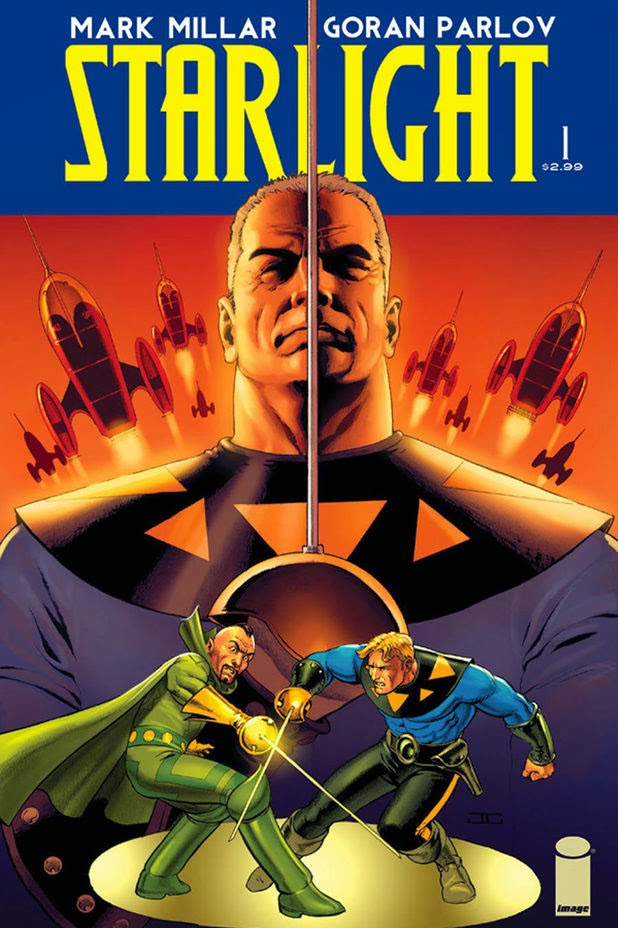
Starlight, written by Mark Millar with art by Goran Parlov, was also a bit of a disappointment. It is clearly a homage to the pulp science fiction (specifically to heroes such as Buck Rogers or Flash Gordon) and both the plot and the art are adapted to that purpose. The illustrations have a quite adequate vintage feeling and the story is straightforward and a bit naive. And that is the main problem. In trying to imitate a pulp story, it becomes a pulp story, and not a especially remarkable one. It plays the card of nostalgia, but it offers no other redeeming virtue. It is just OK, but I expect much more from Mark Millar. Recommended only to hardcore fans of pulp science fiction.

The plot of 7th Sword is not much more original (a samurai is hired to help a village that is threatened by a crime lord) but the overall result is notably better. The combination of robots and martial arts is a bit implausible, but is really fun to read. The art is very good (although the bodies are too angular, sometimes) with some excellent character designs, as in the case Superfecta Five, and a vivid representation of the fight scenes. This comic, written by John Raffo and illustrated by Nur Iman, is not the best thing I've ever read (not even the best thing I've read in the last week), but is entertaining enough and I recommend it if you want to spend a fun couple of hours without further pretensions.

Finally, Outcast, written by Robert Kirman and illustrated by Paul Azaceta, is a really good, solid horror comic-book. Exorcisms, evil beings, mysteries and bit of gore for a gripping plot that really stands out. The start is a bit slow and slightly confusing, but the story gets better with each issue and at by the end of the book I was completely hooked. My only complain is that not much is revealed in this first volume and it will be hard to wait for a new installment to know what happens next. The art is also very good, with an excellent use of color and some interesting page compositions. Highly recommended.

All in all, skip Eden by all means, get Starlight only if you love the old, pulp adventures in space and give 7th Sword a try if the idea of samurais fighting robots sounds like fun to you. But, above all, don't miss Outcast. It is one of the best comics of 2014 and you should be reading it.

(You can also read this review in Spanish/También puedes leer esta reseña en español)