Mostrando entradas con la etiqueta comic. Mostrar todas las entradas

jueves, 27 de agosto de 2026

Royals, by Derek Kirk Kim and Jacob Pérez

(You can also read this review in Spanish/También puedes leer esta reseña en español)

The premise of Royals caught my attention from the very first time I saw it. In this comic, written by Derek Kirk Kim and illustrated by Jacob Pérez, two brothers who share a telepathic bond use their abilities to win poker tournaments in different countries around the world. That is, until they arrive in Seoul, where things get complicated after they find themselves tangled up in a dispute with an organized crime boss.

From this starting point, the plot gradually evolves into a story of the mob, revenge, ambition, and a touch of madness. Perhaps this is what I liked most about Royals: it knows how to start with a clear direction and then slowly complicate the situation, consistently surprising the reader and offering something new in every issue. And it does all of this by following a fairly logical sequence, without taking any blind leaps.

The two protagonist brothers might not be the most charismatic characters in comic book history, but they are complemented by some very interesting supporting characters whose pasts are especially relevant to the story's development. This forces them to face moral dilemmas whose resolutions, although somewhat predictable at times, ultimately prove to be quite satisfying.

Jacob Pérez's artwork perfectly fits both the tone of the story and the characters introduced. He has a style halfway between manga and cartoon that blends incredibly well with the South Korean setting. Furthermore, Pérez handles the action scenes wonderfully; they feel dynamic and are crystal clear for the reader.

In short, Royals is a comic that knows how to evolve beyond its initial premise, consistently giving the reader something more and keeping them hooked from start to finish. The miniseries consists of six issues, with the final one going on sale in early September. Additionally, a collected volume has already been announced (which I had the opportunity to read in an advanced digital review copy), set to be published in November.

viernes, 21 de agosto de 2026

Death Fight Forever, by Andrew MacLean, Alexis Ziritt, Al Gofa, Sam McKenzie and Erwin Papa

Death Fight Forever, created by Andrew MacLean (writer) and Alex Ziritt (artist) and with additional artwork by Al Gofa, Sam McKenzie, and Erwin Papa, is a comic that is brutally honest about what it’s trying to achieve. It’s a crazy, slightly badass tribute to a large chunk of 80s and 90s pop culture, especially arcade video games (Double Dragon, Street Fighter...), action movies (Cobra, Rambo, RoboCop...), and, of course, the comics of that era.

As such, you can imagine that the script isn't particularly deep. The main story is driven by revenge against a big bad villain and features characters with barely any characterization... other than the fact that they are out for revenge. The five issues collected in this trade paperback read in a flash, offering a good mix of fights, brawls, chases, explosions... and little humorous gags, some of which are quite funny. The comic goes out of its way not to take itself seriously, and not only does it succeed, but it has a blast doing so.

To enjoy Death Fight Forever, you have to play along, and I must admit that I was fully on board from the very first page. With character names as on-the-nose as Slyther for a reptilian villain, Thunderfang for a feline soldier, or the Bash & Crash brothers who demolish everything in their path; references that bring to mind the aforementioned movies and games, but also He-Man, ThunderCats, Tron, and many others; deliberately retro artwork like the one you can see on the cover... I understand all of this might scare off more than one reader, but it really clicked with me and I read it from cover to cover with a smile on my face.

The artwork alternates between contributions from Ziritt, Gofa, McKenzie, and Papa, but it remains remarkably consistent throughout the five issues. Perhaps the earlier ones are a bit wilder, while the fourth and fifth (which I liked more visually) are a little more standard. This is the exact opposite of the script, which gets more absurd with every page. A special mention also goes to the fact that the volume I read includes some pretty interesting short interviews with the comic's creators. I don't usually read those extras, but in this case, I actually took a look.

In summary, Death Fight Forever makes no secret of its intention to pay homage to 80s and 90s pop culture products without striving for deeper meaning, aiming for nothing more than to entertain the reader for a while. In my case, it succeeded with flying colors, although I imagine the experience will depend heavily on each person's level of nostalgia and the mood they're in when they sit down to read it. Who knows, maybe it'll be a good fit for you too!

domingo, 16 de agosto de 2026

Preview of Odin, by James Tynion IV, Marguerite Bennett, Letizia Cadonici and Jordie Bellaire


James Tynion IV is, without a doubt, one of the most successful comic book writers today. Series like Something is Killing the Children, The Department of Truth, and The Nice House on the Lake are among the most acclaimed titles by fans in the last decade. So, any new work of his raises massive expectations. That is why, when I had the opportunity to request a review copy of Odin (co-written with Marguerite Bennett, with art by Letizia Cadonici and colors by Jordie Bellaire), I couldn't resist. What I didn't imagine (because it wasn't specified anywhere) was that it was only a preview of thirty-something pages (corresponding, I believe, to the first issue of the series), which has left me a bit wanting more.

Odin is the story of a group of neo-Nazis who plan to summon a Norse god deep in the wilderness of Norway. It is also the story of Adela, a journalist who infiltrates the group with the goal of writing an exclusive story. And, of course, it is the story of how things do not go as expected, and misfortunes and tragedies begin to happen left and right.

And, as they used to say on a popular TVE show many years ago... that's as far as I can read. Because, precisely, that is as far as I was able to read with the preview I was given, from which I haven't been able to draw many conclusions. Is it an interesting story? Yes, undoubtedly. Would I keep reading it? Absolutely! Can I recommend it? Well, I don't know, because I've only been able to taste a tiny fraction of it. But things are looking good.

And speaking of looking good, the artwork is more than adequate without being particularly spectacular. Cadonici more than delivers and is aided, of course, by the always perfect colors of Bellaire. Nothing to object to in that department.

There is little more I can add. It is a work that seems to be very much in line with everything Tynion produces, and I will be delighted to read it in its entirety when it becomes available. In the meantime, it's time to wait.

martes, 11 de agosto de 2026

FML, by Kelly Sue DeConnick and David López

(You can also read this review in Spanish/También puedes leer esta reseña en español)

I had heard great things about FML, the comic scripted by Kelly Sue DeConnick and David López, especially on Entre Cómics, one of my favorite podcasts for finding reliable recommendations. As if that weren't enough, it also scored an Eisner nomination this year. So, I was expecting a masterpiece and while I found a story very different from what I had imagined, its quality didn't disappoint me in the slightest. 

It is hard to describe exactly what you will find within the pages of FML. It has elements of a youth adventure story à la The Goonies or Stand by Me, a few supernatural touches, a heavy dose of slice-of-life, a dash of underground metal storytelling, and a solid serving of a bildungsroman. Still not entirely sure what it is about? It doesn't matter, because discovering all these elements (and many others!) and seeing how they blend together is one of the greatest pleasures of reading this comic. 

FML has some frankly brilliant moments. It is a story that, when it's good, is soooo good. DeConnick keeps many balls in the air at once and juggles them exceptionally well. Inevitably, things occasionally get a little too tangled, causing a slight dip in the pacing and, above all, clarity, but the final result remains outstanding. 

However, what I liked most about FML are its characters. There are a lot of them, they are very diverse, and highly interesting. Despite how 'peculiar' they might be, they are all perfectly characterized and incredibly believable. Interestingly, Riley (who is the supposed protagonist, though your guess is as good as mine) is perhaps the one who flies under the radar the most. Personally, I absolutely loved Patty (Riley's mother) and her friend Amy, as well as the dynamic between them and the secrets slowly revealed about their past. 

David López does a truly phenomenal job on this comic. He handles the stylistic shifts like nobody else, and his close-ups are stunning. The volume I read (a digital Advanced Review Copy) also included some highly interesting extras (and I'm usually not the type to pay much attention to those things). A special shout-out also goes to Cris Peter's coloring, which is simply superb. 

FML is already available in its entirety in English as single issues (eight in total) and will be released as a collected trade paperback in a few months. I haven't heard any news yet about a Spanish publication, but I'm sure it won't take long to be announced because it is a highly recommended read.

martes, 4 de agosto de 2026

D'Orc, by Brett Bean

(You can also read this review in Spanish/También puedes leer esta reseña en español)

D'Orc, written and illustrated by Brett Bean and colored by Jean-François Beaulieu, is one of this year's surprises in the comic book world. Issue #1 of this new Image series sold like hotcakes and began commanding very high prices on the secondary market. I admit it piqued my curiosity, but since the premise didn't really appeal to me, I didn't pay it much attention. However, the title kept making noise and receiving good reviews, so I finally decided to give it a try, something I'm quite glad about, because I liked it a lot. 

The protagonist of the story, also named D'Orc, is half-dwarf and half-orc (hence the name) and finds himself caught in the middle of a deeply entrenched war between the sides of light and darkness. Hated by both factions, D'Orc only wants to be left alone, figure out his origins, and uncover how much truth there is to the prophecy claiming he is destined to destroy the world. 

The tone of D'Orc is distinctly humorous. It reminds me quite a bit of I Hate Fairyland by Skottie Young and Beaulieu himself, but it is even funnier than that (or, at least, it made me laugh more). The pacing gives the reader no respite, and these first five issues collected in the volume I read are over in a flash. Despite this, the plot builds up little by little and leaves us in a rather interesting spot (and wanting to read more) at the end of this trade. 

Without a doubt, what I liked the most are the two characters that accompany the protagonist: the evil shield and the ghost chicken (I don't want to give away too much, because discovering them is part of the fun of reading it, but I assume those names alone have already caught your attention). The dynamic between the three characters is extremely fun, and some of the dialogues are truly hilarious. 

For its part, the artwork more than fulfills its purpose, and in a series with such a lighthearted tone as this one, the cartoonish style is a perfect fit. As I mentioned above, if you've read I Hate Fairyland, I'm sure you know exactly what I mean. 

While it isn't a series destined to change the comic book world, D'Orc is a highly recommended read, especially if you're looking to have a good time and a few laughs. I started it without high expectations and was very pleasantly surprised, so I'll try to get my hands on the next volumes to continue following the adventures of these three crazy characters.

jueves, 24 de septiembre de 2015

Four Image Comics reviews

(Disclaimer: English is my second language, so I want to apologize in advance for there may be mistakes in the text below. If you find any, please let me know so that I can correct it. I'd really appreciate it. Thanks.)

Review Soundtrack: I suggest reading this review while listening to Another One Bits The Dust, by Queen (Spotify, YouTube). 

It's been quite some time since my last review of comic-books. In fact, in the past few months I've been mainly focused on reading novels and short stories, but when I saw that the new volume of C.O.W.L, one of the comics that I enjoyed the most in 2014, was being released, I knew that I had to read it. I also took a closer look at Image Comics latest releases, and selected a couple of the most promising ones. Do you want to know what I thought of them? Just keep reading!

Descender, Volume 1: Tin Stars, written by Jeff Lemire with art by Dustin Nguyen, was a bit of a disappointment. The visual aspects of this graphic novel are really appealing, with an amazing use of the watercolor. The story, however, is, at best, clichéd and simplistic and I found nothing interesting enough to make want to read the next installment. Also, the idea of a "DNA" shared by different robots (which is central to the plot) is so ludicrous that it threw me completely off the book. I'm afraid I can't recommend it. 

Runlovekill, written by Jonathan Tsuei and Eric Canete and drawn by Eric Canete, is a much appealing work. The plot is not exactly what I'd call original, but the pace is quick and the worldbuilding is very interesting, mainly because of the depiction of the dystopian future society and the strong main character, Rain Oshiro. The art is not outstanding, but it's more than correct and perfectly conveys the sense of urgency of the dire situation the main protagonist is in. I did especially like the page compositions and the fight scenes, which are clear and vivid. Not the best graphic novel ever, but really worth your time if you are looking for a science fiction action story.

The Tihe (story by Matt Hawkins, art by Rahsan Ekedal) was quite a pleasant surprise. The story, that includes no science fictional or fantastical elements, follows an FBI investigation. The members of the Samaritan group, a kind of modern Robin Hood band, have been robbing corrupt televangelists and giving money to charity. The plot is fast and straightforward and mostly self-contained, with a clear conclusion to all open threads at the end of issue 4 but, at the same time, preparing things for a new arc in the next installment. The art is just OK, but there are some really brilliant moments (especially in issues 3 and 4) that left me wanting the same level was maintained throughout all the graphic novel. All in all, an interesting work with likable characters and good pace. 

Finally, C.O.W.L. Volume 2: The Greater Good (written by Kyle Higgins and Alec Siegel with art by Rod Reis), the main excuse for having read all the comic-books I'm talking about today, was a good as I expected... or even more. If you've read the first installment (and if you haven't, you should), you already know what to expect: deep characterization, powerful art and a plot full of political intrigue and plans within plans. A perfect example of how the superheroes genre can be much more than just mindless entertainment. Be sure not to miss this one. 

So, again, Image Comics has delivered, with a couple of solid works, a really excellent graphic novel (C.O.W.L., of course) and only one that is disappointing. Image is, currently, the most interesting comic-book publisher out there and I am looking forward to keeping a close eye on their releases.        
  
(You can also read this review in Spanish/También puedes leer esta reseña en español)           

jueves, 26 de marzo de 2015

Three comic-books: Henshin, Criminal and Trees

(Disclaimer: English is my second language, so I want to apologize in advance for there may be mistakes in the text below. If you find any, please let me know so that I can correct it. I'd really appreciate it. Thanks.)

Review Soundtrack: I suggest reading this review while listening to The Trees They Do Grow High, in the version performed by Joan Baez (Spotify, YouTube).

I'm back with three more short reviews of comic-books. In this occasion, the three graphic novels I want to talk about (Henshin, Criminal Vol. 1 and Trees Vol. 1) have all been published by Sense of Wonder favorite Image Comics. But, despite sharing publisher, the books couldn't be more different one from another. 

Henshin, written and illustrated by Ken Niimura, is a very strange comic-book. Very strange indeed. In fact, had not been for the recommendation of my good friend Alexander Páez, I wouldn't have been interested in it. I have read only a few mangas here and there, never enjoying them much since I find it very difficult to understand the Japanese cultural references (especially the humor) and to get into the stories. In this case, it was even worse. The book is composed of thirteen independent but loosely related vignettes that deal with topics so unusual as cat poop. 

Some of the stories interested me more than others. For instance, I quite enjoyed the one about the father and son with telekinetic powers. Also, there are various metaphors that really stand out. The alienation of living in a foreign country, with a different language and a strange culture, for example, is represented in a number of interesting ways. But I must confess that I was unable (and this may very well caused by my many limitations as a reader) to appreciate the meaning of the comic-book as a whole. I was completely baffled while reading it and I'm still baffled days after finishing it. 

Criminal, written by Ed Brubaker with art by Sean Phillips, is another beast entirely. Here, we find Brubaker doing what Brubaker does best: writing crime fiction. This volume, that collects issues 1 through 5, has all the clichés of the noir genre. Corrupt cops, heists, drug addicts, cruel mob bosses, murders, kidnapping - you name it. The plot is very solid (although not especially original) and the characters are well-developed (although not especially sympathetic). If you are into crime fiction, you really need to read this graphic novel (it is self-contained, something is always a plus with comic-books). I recommend it, although I'm not sure I'll be reading the next volumes since I'd rather read stories with a more speculative edge. 

And that is why Trees, written by Warren Ellis and illustrated by Jason Howard, is the comic-book I've liked the most in this lot. Its premise is excellent: some years ago, gigantic alien structures know as trees appeared at different locations of our planet. These mysterious artifacts have strange properties and defy all explanations. And, what is worse, their builders seem to care nothing for us human beings and have not even tried to communicate with us. 

Trees explore, by means of several parallel subplots, the nature of these alien objects and how they have affected and changed the people that live near them. This approach is more akin to what we usually in literary science fiction than in comics, and in fact reminded me of novels such as The Chronoliths, by Robert Charles Wilson. My only complain is that the relevance of some of the subplots, after eight issues, remains yet to be revealed, but I really did enjoy this first volume and I am really looking forward to reading the next installment. 

All in all, I strongly recommend Criminal to crime fiction fans and Trees to science fiction fans. Henshin, on the other hand, is so weird a book that I would only recommend it if you're looking for something completely different and are not afraid of finishing the book without understanding why cat poop is so important after all. You've been warned.    

jueves, 12 de marzo de 2015

Four Comic-books: Eden, Outcast, Starlight and 7th Sword


(Disclaimer: English is my second language, so I want to apologize in advance for there may be mistakes in the text below. If you find any, please let me know so that I can correct it. I'd really appreciate it. Thanks.)

Review Soundtrack: I suggest reading this review while listening to Tubular Bells (Original Theme From The Exorcist) by Mike Oldfield (Spotify, YouTube).  

In this new installment of my short reviews of comic-books I bring you four different graphic novels: Eden, Outcast, Starlight and 7th Sword. As usual, I'll begin with the one I enjoyed the least, leaving the one I recommend the most for the last place. 

Eden, written and illustrated by Bash, has an interesting synopsis involving angels, demons and a village outside our spacetime. However, it is confusing in the extreme, making it almost impossible to know what is happening. After reading this first volume I'd be hard pressed to explain even a little of what is about. I have no idea, really. It might be my own fault, but after reading other reviews I suspect they might be other factors involved. The art is quite good (although it seems a bit rushed or unfinished sometimes) and I think you will enjoy it, especially if you are into manga, but it doesn't begin to make up for the poor plot. 

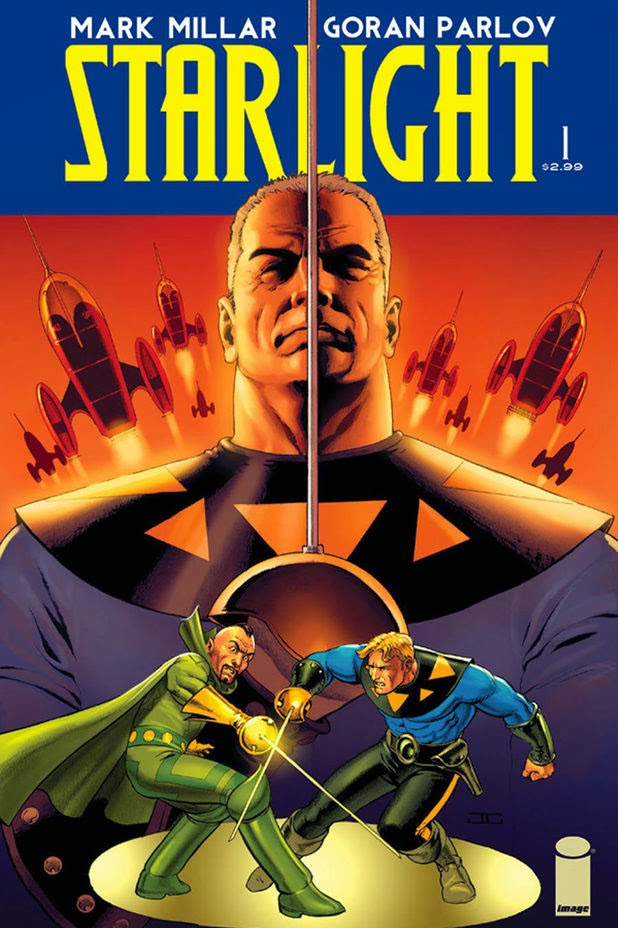
Starlight, written by Mark Millar with art by Goran Parlov, was also a bit of a disappointment. It is clearly a homage to the pulp science fiction (specifically to heroes such as Buck Rogers or Flash Gordon) and both the plot and the art are adapted to that purpose. The illustrations have a quite adequate vintage feeling and the story is straightforward and a bit naive. And that is the main problem. In trying to imitate a pulp story, it becomes a pulp story, and not a especially remarkable one. It plays the card of nostalgia, but it offers no other redeeming virtue. It is just OK, but I expect much more from Mark Millar. Recommended only to hardcore fans of pulp science fiction.

The plot of 7th Sword is not much more original (a samurai is hired to help a village that is threatened by a crime lord) but the overall result is notably better. The combination of robots and martial arts is a bit implausible, but is really fun to read. The art is very good (although the bodies are too angular, sometimes) with some excellent character designs, as in the case Superfecta Five, and a vivid representation of the fight scenes. This comic, written by John Raffo and illustrated by Nur Iman, is not the best thing I've ever read (not even the best thing I've read in the last week), but is entertaining enough and I recommend it if you want to spend a fun couple of hours without further pretensions.

Finally, Outcast, written by Robert Kirman and illustrated by Paul Azaceta, is a really good, solid horror comic-book. Exorcisms, evil beings, mysteries and bit of gore for a gripping plot that really stands out. The start is a bit slow and slightly confusing, but the story gets better with each issue and at by the end of the book I was completely hooked. My only complain is that not much is revealed in this first volume and it will be hard to wait for a new installment to know what happens next. The art is also very good, with an excellent use of color and some interesting page compositions. Highly recommended.

All in all, skip Eden by all means, get Starlight only if you love the old, pulp adventures in space and give 7th Sword a try if the idea of samurais fighting robots sounds like fun to you. But, above all, don't miss Outcast. It is one of the best comics of 2014 and you should be reading it.

(You can also read this review in Spanish/También puedes leer esta reseña en español)             

jueves, 12 de febrero de 2015

Three Comics: Mind the Gap, City on the Edge of Forever and Dark Engine

(Disclaimer: English is my second language, so I want to apologize in advance for there may be mistakes in the text below. If you find any, please let me know so that I can correct it. I'd really appreciate it. Thanks.)

Review Soundtrack: I suggest reading this review while listening to Hello by Lionel Ritchie (Spotify, YouTube). 

Time for another installment of my short reviews of comic-books! Today, I'll briefly comment my impressions after reading Dark Engine Volume 1: The Art of Destruction, Start Trek: The City on the Edge of Forever and Mind the Gap Volume 1: Intimate Strangers. The bottom line is that, sadly, I didn't enjoy any of them very much. 

This first volume of Dark Engine collects issues one to four, written by Ryan Burton and illustrated by John Bivens. When I read the synopsis (that involves alchemists, magic and time travel) I thought it really intriguing, but then I was very disappointed with the actual content of the book. The plot is unclear and uninteresting and the art does not help in following the story: confusing and with dark colors, I didn't find it to my taste. I can't recommend this comic-book and I, for one, am not interested in reading the next volume. 

The City on the Edge of Forever is, apparently, one of the most famous episodes of the original Star Trek TV series (in fact, it won the Hugo Award in 1968) and this comic-book published by IDW is said to be an adaptation in five issues of the teleplay as written by Harlan Ellison. With this credentials, I was really interested in reading the comic-book, but was once again disappointed. 

I have never been a Star Trek fan (I've only watched a couple of the movies and the odd episode here and there) and this book is a perfect example of why. The plot of The City on the Edge of Forever is exactly the opposite of Dark Engine: simple, naive and predictable. The art by Juan Ortiz and J.K. Woodward, is excellent, but doesn't make up for the dull story. Recommended only to hard-core trekkies, I'm afraid. 

Mind the Gap, written by Jim McCann and illustrated by Rodin Esquejo, is the best of the lot, but nothing to write home about. I became interested in this comic because I am a huge fan of Esquejo's covers for Morning Glories and, in fact, the synopsis of the series seems to be on the same line of mystery with a paranormal twist. Esquejo certainly delivers (although there are some weird facial expressions in some places and the page compositions are a bit stiff) but the plot is only so-so.

For a book that relies on creating mysteries, the pace is too slow and there some conflicts and potential twists that are hint at but not shown clearly, resulting in a somewhat bland storyline. This volume collects issues one to five and in the last ones the plot seems to me more focused, with a nice cliffhanger at the end of episode 5. For that only, I think I might give a try to the next volume, but it is not high among my priorities. 

All in all, three comic-books that disappointed me for different reasons and that I think you can skip without missing too much. Mind the Gap shows some potential, so you might want to take a look at it to see if it catches your interest, but be warned that it is not especially outstanding. I hope to be more lucky with my next comic-book readings. 

(You can also read this review in Spanish/También puedes leer esta reseña en español)       

jueves, 18 de diciembre de 2014

Otras tres reseñas de cómics


Banda sonora de la reseña: Sugiero leer esta reseña escuchando The Kiss of Judas, de Stratovarious (Spotify, YouTube).

Es hora de una nueva entrega de reseñas de cómics. Quedé especialmente satisfecho con los tres que leí y reseñé la última vez, pero, por desgracia, no puedo ser tan entusiasta con las novelas gráficas de las que quiero hablar hoy.

No quedé del todo satisfecho con Meka cuando lo leí hace un par de meses, pero sí que le vi bastante potencial. Así que decidí darle una oportunidad a Luminae, que esta vez no está sólo ilustrado sino también guionizado por Bengal. Tampoco esta vez quedé demasiado impresionado con el libro. El dibujo es bastante bueno (aunque quizá demasiado estilo manga algunas ves), pero las escenas de lucha son, otra vez, poco claras y los personajes se parecen demasiado para diferenciarlos con claridad.

El guión no es mejor. La trama es bastante sencilla (la típica lucha entre el bien y el mal) pero los constantes cambios de escena hacen que sea difícil de seguir. Además, hay poco desarrollo de los personajes y el final cae en el cliché. Parece ser que se trata del primer volumen de una serie, pero no estoy para nada interesado en leer el siguiente: éste es bastante autoconclusivo y no ha conseguido despertar mi curiosidad.

Judas: The Last Days, escrito por W. Maxwell Prince e ilustrado por Jon Armor, parte de una premisa bastante interesante: Judas Iscariote ha sobrevivido durante 2000 años después de traicionar a Jesús, pero ahora quiere morir. La trama real de la novela gráfica es, de hecho, bastante más extraña que todo eso y se vuelve más extraña a cada página. Apóstoles inmortales que son adictos a las drogas, políticos o transexuales se entremezclan con elementos de metaficción (e, incluso me atrevería a decir, de hiperstición) para dar lugar a un libro extrañísimo que con seguridad confundirá al lector promedio y ofenderá a aquellos que tengan profundos sentimientos religiosos.

El dibujo, que va mejorando según avanza el libro, me gustó bastante. Creo que el uso del color, con diferentes paletas para los diferentes escenarios, es muy acertado y las composiciones de página menos convencionales funcionan realmente bien. En resumen, un cómic con algunas buenas ideas pero posiblemente demasiado ambicioso como para salir bien. Podéis darle una oportunidad si os apetece probar algo diferente.

El mejor del lote (aunque eso no signifique demasiado en este caso) es The Squidder (guión y dibujo de Ben Templesmith). Un pastiche lovecraftiano situado en un mundo post-apocalíptico, este cómic combina elementos de la ciencia ficción, el terror y la novela negra. La trama no es especialmente original, pero funciona de forma aceptable y tiene un buen desarrollo de los personajes.

Las ilustraciones son excelentes y están dotadas de una enorme personalidad. El uso del color es fascinante (pero, por desgracia, hace que sea difícil leer el texto algunas veces) y las splash-pages y las composiciones son realmente impresionantes. Todo ello contribuye a crear una atmósfera opresiva y decadente que es perfecta para la historia. Recomendaría The Squidder sólo por sus ilustraciones; la trama, aunque algo trillada, también colabora en el resultado final.

En definitiva, tres cómics que podéis dejar pasar sin mayor problema si no disponéis de mucho tiempo. Se le puede echar un vistazo a Judas: The Last Days si buscáis probar algo diferente y, especialmente, a The Squidder si os gustan las buenas historias post-apocalípticas con un acompañamiento de tentáculos y disfrutáis del buen dibujo con un coloreado potente.

Another Three Comic-book Reviews


(Disclaimer: English is my second language, so I want to apologize in advance for there may be mistakes in the text below. If you find any, please let me know so that I can correct it. I'd really appreciate it. Thanks.) 


Review soundtrack: I suggest reading this review while listening to The Kiss of Judas, by Stratovarious (Spotify, YouTube).

It is time for yet another batch of short reviews of comic-books. I was especially pleased with the three I reviewed in my last installment of this section but, unfortunately, I am not so enthusiastic with the graphic novels I want to write about today. 

I was not completely satisfied with Meka when I read it a couple of months ago, but it certainly showed a lot of potential. Thus, I decided to give Luminae a try, this time not only illustrated but also written by Bengal. Again, the book failed to impress me. The art is quite good (although a bit too manga-style sometimes), but the fight scenes are, once more, not that clear and the characters are too much alike to easily tell them apart. 

The writing is not better. The plot is quite straightforward (typical good vs. evil battle) but the constant changes of scene make it difficult to follow. There is little development of the characters and the ending is a bit clichéd. It seems that this is the first volume in a series, but I'm not really interested in reading the next: this one stands perfectly well on its own and failed to pique my curiosity.

Judas: The Last Days, written by W. Maxwell Prince and illustrated by Jon Armor, has a very interesting premise: Judas Iscariot has survived for 2000 years after betraying Jesus, but now he wants to die. The actual plot of the graphic novel is, in fact, much more weird than that and it gets weirder with every page. Inmortal apostles that addicted to drugs, politicians or transsexual intertwine with elements of metafiction (and of hyperstition, I'd dare to say) to give raise to a weird book that will most surely baffle the average reader and offend those with hardcore religious beliefs. 

I did enjoy the art, which gets better in the final part of the book. I found that the use of colour, with different palettes for different settings, was really spot-on and some of the less conventional page compositions worked really well. All in all, a comic-book with some interesting ideas but possibly too ambitious for its own good. Give it a try if you're in the mood for something different. 

The best of the lot (although that doesn't mean much in this case) is The Squidder (script and art by Ben Templesmith). A Lovecraftian pastiche set in a post-apocalyptic world, this graphic novel combines tropes from science fiction, horror and noir fiction. The plot is not especially original, but works well enough, with good character development.

The art is just excellent and shows a lot of personality. The use of the colour is brilliant (but, unfortunately, makes the text difficult to read sometimes) and the splash-pages and page compositions are impressive. It all contributes to create an oppressive and decadent atmosphere that is just perfect for the story. I'd recommend The Squidder for the art alone, and the plot, although a bit trite, also helps.

All in all, three comic-books that you can feel perfectly free to miss if you're in a hurry. You can try Judas: The Last Days if you feel like trying something different and, especially, The Squidder if you enjoy a good post-apocalyptic story with a side order of tentacles to go with it and also appreciate good art and powerful coloring.

(You can also read this review in Spanish/También puedes leer esta reseña en español)

lunes, 24 de noviembre de 2014

Three Image Comics Reviews

Review Soundtrack: I suggest reading this review while listening to Wicked Ways, by Garbage (Spotify, YouTube).

Image is, probably, my favorite comic-book publisher at the moment. Obviously, not all their books are of the same quality, but I love the way they support original and bold stories. Recently, I've had the chance of reading the first volume of three of their new series and was, again, surprised and very satisfied.

Shutter, written by Joe Keating and illustrated by Leila del Duca, though quite enjoyable was my least favorite of the three. It follows closely on the success of Saga, with a wild combination of science fiction and fantasy tropes. Kate Kristopher, the main protagonist, lived many adventures in exotic worlds with her father when she was a young girl. Now, twenty years after, her past is trying to catch up with her even if she wants to forget and live a quite life. 

I found the first issues to be a bit rushed, and the story becomes much more interesting when flashbacks of the life of Kate are introduced to provide context. The art is very good, with some moments of sheer brilliancy, and it only gets better with each issue. All in all, a good (but not excellent) comic-book that would benefit from a slightly slower pace. I might be reading the next volume, but I'm not exactly holding my breath to know what happens next.  

I did like The Wicked + The Divine, written by Kieron Gillen with art by Jamie McKelvie, better. The premise is amazing (a pantheon of gods that, every 90 years, "possess" young boys and girls giving them divine powers), although not completely exploited in this first five issues, which are a bit uneven. For instance, some of the characters are just fascinating (especially Luci) while others are not that well developed. The plot meanders a bit and ends with a cliffhanger that is not very surprising, but that leaves the story at a really interesting point.    

The art is, as in the case of Shutter, very good. I just love the covers, for instance, and all the imagery of the gods as pop-stars is superb. Again, this works better for some characters than for other, but it is quite consistent through the volume. There are also some intelligent page compositions that really add a lot and help telling the story. Despite the pace problems, this is one I will most surely be reading when the next volume comes out. 

And we arrive at my favorite of the three: C.O.W.L., written by Kyle Higgins and Alec Siegel and illustrated by Rod Reis. Imagine Watchmen meets The Wire and you will get a close idea of what the plot of this comic-book is about. The C.O.W.L. of the title is, in fact, a union of super-powered people that work for the police department of Chicago in the '60s. They have just been able to put the last super-villain into jail and now they face a new era in which they might be not so necessary. The plot focuses on the political, social and economic problems that arise in this new situation. 

The atmosphere, the pace of the story and the development of the characters are almost perfect, as is the art, which shows a lot of personality. The first issues are a bit difficult to follow, but once we get to know the main protagonists it is impossible to stop reading. The end of the first volume is not exactly surprising, but is the only possible resolution given the facts and I'm really looking forward to seeing how everything develops.

Image does not disappoint and these are three comic-books that I really recommend checking out, especially C.O.W.L. for its overall quality and The Wicked + The Divine for its potential. I, for one, will keep a close eye on anything published by Image.  

jueves, 30 de octubre de 2014

Comic-book reviews: Nailbiter and War Cry

(Disclaimer: English is my second language, so I want to apologize in advance for there may be mistakes in the text below. If you find any, please let me know so that I can correct it. I'd really appreciate it. Thanks.)

Review Soundtrack: I suggest reading this review while listening to Nailbiter, by Sister Sin (Spotify, YouTube).

After several not very satisfying reads, I've found a couple of comic-books that I've thoroughly enjoyed: War Cry, written by Jim Butcher and illustrated by Carlos Gomez, and Nailbiter, written by Joshua Williamson with art by Mike Henderson. 

War Cry is a story set in the popular Harry Dresden saga. Despiste the frequent recommendations of my friends (most notably Miquel Codony, who is a huge fan of the series) I have not yet read any of the novels, so I thought reading this comic could be an easier starting point. I knew that I would be missing some of the finer points (the story is set after Dead Beat, which is the seventh Harry Dresden book), but this graphic-novel stands quite well on its own (it includes all five issues of the mini-series) and I had no major problems understanding (and enjoying) it. In fact, it made me want to read the saga as soon as possible, which I think is as good a praise as I can give.

War Cry is fast-paced and action-packed. The five issues all set during the siege of a house which contains a mysterious object and features a lot of battle scenes. Thus, I think it was a very good decision to write the story in comic-book form since it perfectly suits the contents: less character-driven and more action-oriented. The plot is gripping and the characters, although a bit clichéd, are interesting and charismatic. The art is also quite good, especially in the battle scenes, which are clear and vivid. The expressions of the characters seem a bit forced sometimes and their faces are "too angular," but nothing especially problematic. Recommended if you want to have a good, fun time, and especially if you are a fan of the series. 

Nailbiter is even better than War Cry and, in fact, one of the best comics I've read in a long time. I had great expectations for this one because the synopsis was really intriguing (a small town which is home to SIXTEEN different serial killers), but they were all more than met. Both the writing and the art are excellent, combining to create an incredible atmosphere of mystery and fascination that will make you want to read page after page to know what happens next (I, for one, am eagerly awaiting for the next installment). 

This first volume of Nailbiter, which collects the first five issues of the series, has surprising twists, interesting characters, a wonderful cinematographic style and even some humor. Some of the scenes are a bit gory, as you can expect from the topic at hand, and might be not to the taste of those with a weak stomach. In no case, though, do the authors fall into showing gratuitous violence or blood and gore just for the sake of it. In fact, if you like movies such as Seven or The Silence of the Lambs (to which the comic pays explicit homage) you will love Nailbiter. Highly, highly recommended.

All in all, two graphic novels that, despite being quite different one from another, made me had an excellent time. War Cry is good urban fantasy with tons of action and Nailbiter is a gripping thriller with a hint of the supernatural and superb writing and art. I recommend them both, especially Nailbiter which is one of the best comics I've read since Locke & Key. And that is a lot to say. 

lunes, 13 de octubre de 2014

More short reviews of comic-books

Disclaimer: English is my second language, so I want to apologize in advance for there may be mistakes in the text below. If you find any, please let me know so that I can correct it. I'd really appreciate it. Thanks.)

Review Soundtrack: I suggest reading this review while listening to Long Live Rock 'N' Roll, by Rainbow (Spotify, YouTube).

It seems that my short reviews of comic-books, published a couple of weeks ago, were received quite well. So, since I am still trying to catch up with reading graphic novels, I have decided to write this kind of post with a certain periodicity. This time, I will focus on two comics that I've recently read and that are quite different in intention and quality.

Star Mage, written by J.C. De La Torre and illustrated by Ray Dillon was a big disappointment. The idea of science-fantasy on a Space Opera setting sounded really interesting and fun, but this trade edition that includes the first six issues of the series leaves a lot to be desired. The plot has been seen thousands of times and has a lot of holes in it. In fact, Star Mage is a dull and clumsy rewriting of Harry Potter with some ideas taken from Green Lantern and Superman. For instance, the Star Mages cast spells by means of incantations such as "Sepsu Batilu" and "Daku Scullsphere" (I wouldn't have been surprised to see one of them saying "Expecto Patronum" at some point). Also, for some reason, the word "necromancer" is used to describe these space wizards although their magic has nothing at all to do with death.

The art is slightly better than writing, especially in the first issue, but nothing to write home about. It relies to heavily on the use of primary colors and on some easy tricks such as depicting the characters with light coming from their eyes and hands to remind us that they magical powers. Oh, and the way of drawing the villain (who is really similar to Sinestro, from Green Lantern) is one of the less subtle resources I've seen in a lot of time.

Doomboy, written and illustrated by Tony Sandoval, is completely different. A much more intimate story with just a small hint of the supernatural that is ambiguous enough to be interpreted in many different ways. The plot explores friendship, love and loss and how they can be an inspiration for the creation of artistic work, especially music, and how, in turn, this creative process can help overcome grief.

Sandoval's art for Doomboy really stands out. It is as personal as powerful, with an amazing use of the graphical to express metaphors and convey the deepest feelings. Sandoval also excels at showing instead of telling, with a wonderful talent for deciding what to depict clearly and what to only imply. I was attracted to this graphic novel because I am a long-time fan of heavy metal, but I found something much more deep and delicate than I expected, that can appeal to very wide audience.

Thus, I recommend giving Doomboy a try if you are intrigued by the synopsis and are willing to embark on something different. It is not a superb work, especially because the plot is quite simple, but is sincere and personal, with powerful and emotional art. On the other hand, avoid Star Mage at all costs. It seems to be oriented to the YA market, but even the most inexperienced readers will be disappointed with this cheap attempt. I expected much better from IDW.

(You can also read this review in Spanish/También puedes leer esta reseña en español) 

jueves, 2 de octubre de 2014

Tres reseñas cortas de cómics

Nunca he sido un gran lector de cómics. Pero hace unos años pasé una etapa en la que leía casi tantos (o más) cómics como novelas, y descubrí un buen número de obras excelentes. Por una u otra razón, últimamente estoy leyendo cada vez menos novelas gráficas y he decidido que es hora de intentar ponerse al día y me he puesto con un par de títulos que han despertado mi interés. Por desgracia, la experiencia no ha sido tan buena como esperaba.

En primer lugar, quiero hablar de Saga, el muy celebrado cómic guionizado por Brian K. Vaughan con dibujos de Fiona Staples. Se trata, muy posiblemente, de unos de los cómics más exitosos de los últimos años, así que mis expectativas eran muy altas. Debo decir que no me impresionó. De hecho, leí el primer volumen el año pasado (cuando estuvo nominado para un Hugo que, finalmente, ganó) y no lo he reseñado hasta ahora porque me sentí bastante decepcionado con lo que me encontré.

Sí que me gustó el hecho de que Saga combinara elementos de distintos géneros y también disfruté con las ilustraciones que, en ocasiones, me recordaron a la Saga de los Metabarones. Pero la trama me pareció bastante floja y un tanto deslavazada. Mi principal objeción, sin embargo, es la sensación de que los autores ponían demasiado empeño en intentar impactar al lector, la mayor parte de las veces con giros de guión retorcidos y poco naturales. En suma, y aunque sé que no es una opinión generalizada, no encontré nada que interesara lo suficiente como para leer el siguiente volumen.
  
E.G.O.s Volume 1: Quintessence, escrito por Stuart Moore con dibujo de Gus Storms, también intenta impactar al lector con un acercamiento supuestamente original a temas clásicos. El cómic combina superhéroes tradicionales con tropos de ciencia ficción. A priori, suena prometedor, y me intrigó lo suficiente como para darle una oportunidad. Lamentablemente, el resultado final deja mucho que desear.

El aspecto más destacable es la voz del narrador, que es fresca y divertida. El resto de elementos, sin embargo, no llegan a alcanzar el nivel esperado. La trama se inspira en cómics muy conocidos, con un villano que es muy similar a Galactus y unos conflictos dentro del grupo de superhéroes que he leído, por ejemplo, en Ultimate Avengers. Pero la peor parte (y ni siquiera estoy mencionando la completamente ridícula "ciencia") es una trama predecible y nada interesante que no consigue enganchar al lector. Las ilustraciones tampoco ayudan; son poco detalladas y dejan una incómoda sensación, al menos para mi gusto, de estar sin terminar (podría ser un efecto buscado, pero a mí me resultó bastante poco atractivo).

Finalmente, Meka, escrito por J.D. Morgan e ilustrado por Bengal, parecía una apuesta segura. ¡Robots gigantes! ¡Batallas épicas! Me esperaba algo en la línea de Pacific Rim, pero me encontré con algo bastante diferente. De hecho, a las pocas páginas, la trama se centra en una historia mucho más personal, en la que el énfasis se pone en la relación entre los dos protagonistas principales. Me llevó un tiempo olvidar mis expectativas y entonces fui capaz de disfrutar con la evolución de los personajes (especialmente en el caso de la cabo), pero me temo que algunos lectores se sentirán bastante decepcionados si buscan una historia de más acción. Además, el final me pareció un tanto precipitado y bastante anticlimático.

En cuanto a las ilustraciones, tengo sentimientos encontrados. Por un lado, creo que tiene mucha personalidad y que transmite muy bien las emociones de los personajes. Por el otro, pienso que Bengal abusa de los planos cortos incluso cuando la escena parece demandar enfoques mucho más abiertos. Además, el dibujo, en general, está extrañamente desenfocado, algo que encontré tan confuso como molesto.

En resumen, no puedo recomendar ninguno de estos tres cómics. Meka es, probablemente, en el que más me ha gustado de los tres, pero tampoco es como para tirar cohetes. No puedo evitar sentirme un poco decepcionado con mi intento de regresar al mundo del cómic. Supongo que tendré que seguir buscando.

(You can also read this review in English/También puedes leer esta reseña en inglés)                       

Three comic-books short reviews

(Disclaimer: English is my second language, so I want to apologize in advance for there may be mistakes in the text below. If you find any, please let me know so that I can correct it. I'd really appreciate it. Thanks.)

I've never been a hardcore comic-book reader. But a few years back I had phase in which I was reading as much comics (or even more) as novels, and I discovered quite a number of excellent works. For some reason or other, I have read fewer and fewer graphic novels lately and I decided it was time to try to catch up, so I picked up a couple of comic-books that piqued my interest. Unfortunately, the experience was not as good as I expected.

First of all, I want to talk about Saga, the celebrated comic-book written by Brian K. Vaughan with art by Fiona Staples. This is, quite possibly, one of the most successful comics of the last few years, so my expectations were very high. I must say I was not impressed. In fact, I read the first volume last year (when it was nominated for a Hugo Award that it eventually won) and I failed to review it until now because I was quite disappointed with what I found.

I did enjoy the fact that Saga combines elements from different genres and I also quite liked the art, which reminded me of, sometimes, of The Saga of the Meta-Barons. But I found the plot very weak and not very cohesive. My main problem, though, was the feeling that the authors were trying too hard to impact the reader, most of the time with contrite and artificial plot twists. All in all, and though I know it is not a popular opinion, I didn't find anything engaging enough to make read the next volume.

E.G.O.s Volume 1: Quintessence, written by Stuart Moore with art by Gus Storms, also tries to impact the reader with a supposedly original approach to classic themes. This comic combines traditional superheroes with science fiction tropes. A priori, it sounds promising, and it intrigued me enough to give it a try. Sadly, the result leaves a lot to be desired.

The most enjoyable aspect is the voice of the narrator, which is fresh and funny. The rest of the elements, however, don't live up to the expectations. The plot borrows from well-known comics, with a villain that is very similar to Galactus and conflicts inside the superhero team that I have read, for instance, in Ultimate Avengers. But the worst part (and I am not even mentioning that the "science" is completely ludicrous) is an uninteresting and predictable plot that fails to engage the reader. The art doesn't help either; it lacks details and feels, at least to my taste, awkwardly unfinished (it might be an intended effect, but I quite disliked it).

Finally, Meka, written by J.D. Morgan and illustrated by Bengal, was what I thought to be a safe bet. Giant robots! Epic battles! I was expecting something in the vein Pacific Rim, but what I found was quite different. In fact, after just a few pages, the plot focuses on a more personal story, in which the emphasis is on the relationship of the two main protagonists. It took me a while to discard my expectations and then I quite enjoyed the evolution of the characters (especially in the case of the corporal), but I am afraid that some readers will feel disappointed if they are looking for a more action-oriented story. Also, I found the ending to be a bit rushed and somehow anticlimactic. 

Regarding the art, I have mixed feelings. On the one hand, I think it has a lot of personality and works very well in conveying the emotions of the characters. On the other, I think Bengal abuses of the close-ups even when the scene seems to demand a long shot. Also, the illustrations, in general, are strangely out of focus, something that I found as awkward as confusing.

All in all, I cannot recommend any of these three comic-books. Meka is probably the one that I enjoyed the most, but it is nothing to write home about anyway. I can't help feeling a bit disappointed with my trying to return to comics. I guess I should keep on searching.

(You can also read this review in Spanish/También puedes leer esta reseña en español)