lunes, 5 de noviembre de 2012

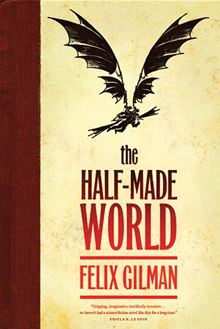
Ebook Deal: The Half-Made World by Felix Gilman

As of now, you can get The Half-Made World by Felix Gilman for only $2.99 (€2.49) from Amazon and Kobo. At Kobo, in fact, you can apply coupons (see, for instance, the right side of the excellent Books on the Knob) to get it even cheaper. The book is DRM-free so it can be converted easily for any ereader.

This is the product description:

A fantastical reimagining of the American West which draws its influence from steampunk, the American western tradition, and magical realism

The world is only half made. What exists has been carved out amidst a war between two rival factions: the Line, paving the world with industry and claiming its residents as slaves; and the Gun, a cult of terror and violence that cripples the population with fear. The only hope at stopping them has seemingly disappeared—the Red Republic that once battled the Gun and the Line, and almost won. Now they’re just a myth, a bedtime story parents tell their children, of hope.

To the west lies a vast, uncharted world, inhabited only by the legends of the immortal and powerful Hill People, who live at one with the earth and its elements. Liv Alverhyusen, a doctor of the new science of psychology, travels to the edge of the made world to a spiritually protected mental institution in order to study the minds of those broken by the Gun and the Line. In its rooms lies an old general of the Red Republic, a man whose shattered mind just may hold the secret to stopping the Gun and the Line. And either side will do anything to understand how.

Interview with Karin Tidbeck

My good friend Pedro Román has recently reviewed Jagannath by Karin Tidbeck, an extremely interesting collection of short stories. Today, he has published an interview with the author in Spanish and he has been so kind as to letting me simultaneously publish the original version in English. Enjoy! 

Pedro Román: What is the state of science fiction and fantasy in Sweden?

Karin Tidbeck: Things are getting better and better. The genre was in a long slump during the 90's and early 00's, but now blogs, magazines and publishers are popping up everywhere. The larger publishing houses are also showing interest in fantastic fiction. A bunch of new authors have arrived on the scene in recent years, mostly in horror, urban fantasy and high fantasy. There's also been a boom on the sf/fantasy comics scene, which is great, because Sweden does have a long tradition of quality comics. I'm very optimistic of the future.

PR: A few weeks ago, I recommended new scifi/fantasy Spanish writers to study English and have their works translated, as the local market is quite… complex. It seems you took that very advice several years ago. Was it the only way to expand frontiers for your work? Do you think it is a good choice? Is it the only one?
 
KT: At the time, it seemed like the only viable choice for me. However, there were other ways I could have taken to expand in Swedish, but that would have required more work, like starting a magazine of my own or self-publishing. I don't have that kind of energy, but I admire those who have. One of the main reasons the Swedish scene is looking up now is because a bunch of very creative people have done just that. Even so, expanding into English means a larger audience, both because there are about a gazillion more potential readers, but also because Swedish literary culture still looks down on fantastic fiction. As an example, while both my books in Swedish have gotten a ton of love from book bloggers, genre magazines and the all-important library registry (you get a good review there, you ensure presence in the public libraries), regular magazines and journals have shown almost zero interest. This is par for the course when writing fantastic fiction except when the handful of journalists sympathetic to the genre make an effort to bring it forward. I'm in general extremely annoyed about the rigid ordering into genres – people fixate on whether it's social realism or not, instead of looking at themes and narrative.

PR: How do you define your work?
 
KT: I don't. I often get that question, but I don't really want to go beyond saying "fantastic fiction" or "stories". See my annoyance regarding genre division. I'm using various terms to describe what's going on in Sweden, but really, genre terms should be used only when needed as a tool for discussion or analysis. I think it's way more important to discuss what goes on in the stories rather than ”does it have dragons or rockets? Is it real fantasy or not?”. I don't know if I even feel like using the term ”fantastic fiction” anymore, because people hang onto that instead of talking about what the stories are about. They don't do that with social realism.

PR: Most of your tales draw from Nordic myths. However, you use not the well-known Norse Gods but rather the unknown domestic beings. As an expert in comparative religion, one could think your first base would be Thor, Odin and the like. Was it a conscious choice to ignore the huge and explore the small?  If so, why? 

KT: I write about people, sometimes about people that aren't humans. The human/not-quite-human territory fascinates me, the in-between states. As someone who was reared on Norse mythology, the Aesir and Vanir are a little boring in comparison. They're gods, they go on adventures and get in trouble and punish humans or each other. We know all about them, their stories are written. Stories about gods are also a different beast than stories about folkloric creatures: traditionally, myths about gods are a way to explain why the world looks the way it does, where we come from, what happens after death, what rules there are and what happens if you break them. Basically they define reality and our place in it. When you start to involve gods in your fiction, it's inevitable that this aspect creeps in.
In Nordic folklore, as in many other places, humans didn't have direct contact with gods except extremely rarely. They saw vittra, gnomes, nixies, trolls, changelings. The gods were huge, abstract beings that you didn't really want to bump into. Folklore often deals with more immediate human problems: why is my cow not giving milk? Why does my baby look different than other babies? What was that creature standing next to my bed and why couldn't I move? It used to be trolls and witches – these days it's aliens (or governmental conspiracies). We compulsively tell stories about these folkloric creatures that we feel are there but aren't humans, and not gods, and might be from here or elsewhere. They're very interesting.

PR: Jagannath is the name of an Indian Deity which means “World” and has no legs. At first I thought it was a sort of joke, as your jagannath is a world in itself but  many-legged. Later I came up with a deeper idea of the story as a sort of metaphor of our own world and its deficient running course. What is the truth behind Jagannath?
 
KT: I don't write my stories as metaphors, so my intention is exactly what you can see on the page. I'm delighted that readers can find deeper layers of meaning in the text, though. That's how it's supposed to work. I chose the name (which to my understanding means "Lord of the world") because of the sensation it describes, rather than going for the etymological meaning. In the story, Mother is an enormous creature driven forward by a myriad of workers, crushing and eating everything in her way. That sensation a huge, sentient being with an almost unstoppable inertia led me to the concept of the Jagannath. In hindsight, the etymological meaning works well, too. Mother is, after all, the lady of the world in a sense.

PR: “August Prima” has a distinctive Carrollian taste; “Arvin Pekon”, Kafkaesque. Which are your writing influences?

KT: They're from many different places. I could name some: Tove Jansson, H P Lovecraft, Samuel Delany, Elizabeth Hand, Neil Gaiman, Ursula K Le Guin; the comics of Alan Moore, Frank Miller and Enki Bilal. I'm just naming writers I love, here – it's always hard to tell what's actually influenced you and whose works you just enjoy. Everything you see and hear is fodder for the mental compost heap. I've not read Kafka very extensively. I guess we're just kindred spirits.

PR: “Aunts” is maybe the weirdest tale of this collection, not only because of the story itself but also because it cannot be read in isolation — reading “August Prima” before is needed to understand it fully. Both tales work extremely well together and offer insights into a very interesting universe. Do you plan to release more tales within it?
 
KT: I'm considering it, yes. I have a few more stories within that same world that I'm working on translating. I have a lot on my plate at the moment, but it's possible!

PR: You have just published your first novel, Amatka, in Swedish. What can you tell us about it? When will we see it published in English?

KT: Amatka is a ”utopian dystopia” of sorts – it's about colonizing a world where reality behaves in a very different way from what we're used to. It has a lot to do with exploring language and its effect on consciousness and reality. I'm working on a translation right now.

PR: What can you tell us of your future plans?

KT: The translation of Amatka into English, building a new story collection in Swedish, then translating that into English. I wish I could work more on producing new material, but since I'm writing everything twice, it's slow going.
domingo, 4 de noviembre de 2012

Winners of the World Fantasy Awards

The winners of the World Fantasy Awards have just been announced:

Novel

•  Osama, Lavie Tidhar (PS Publishing)

Novella
 
•  "A Small Price to Pay for Birdsong", K.J. Parker (Subterranean Winter 2011)

Short Story

•  "The Paper Menagerie", Ken Liu (F&SF 3-4/11)

Anthology

•  The Weird, Ann & Jeff VanderMeer, eds. (Corvus; Tor, May 2012)

Colection

•  The Bible Repairman and Other Stories, Tim Powers (Tachyon)

Artist

•  John Coulthart

Special Award (Professional)

•  Eric Lane (Dedalus Books translations) 

Special Award (Non professional)

•  Raymond Russell & Rosalie Parker (Tartarus Press)

Congratulations to all the winners! 

The Spanish translation of "The Paper Menagerie" by Ken Liu (also winner of the Hugo and Nebula awards) will be published soon in the first volume of Terra Nova. 

Note: You can read my interviews with two of the winners: Ken Liu and Lavie Tidhar.

Ganadores de los World Fantasy Awards

En el marco de la World Fantasy Convention se acaban de entregar los World Fantasy Awards. Los ganadores han sido los siguientes:

Novela

•  Osama, Lavie Tidhar (PS Publishing)

Novela corta
 
•  "A Small Price to Pay for Birdsong", K.J. Parker (Subterranean Winter 2011)

Relato

•  "The Paper Menagerie", Ken Liu (F&SF 3-4/11)

Antología

•  The Weird, Ann & Jeff VanderMeer, eds. (Corvus; Tor, Mayo 2012)

Colección de relatos

•  The Bible Repairman and Other Stories, Tim Powers (Tachyon)

Artista

•  John Coulthart

Premio Especial (Profesional)

•  Eric Lane, por sus publicaciones de traducciones en Dedalus books 

Premio Especial (No profesional)

•  Raymond Russell & Rosalie Parker, por Tartarus Press

¡Enhorabuena a los ganadores! Os recuerdo que "The Paper Menagerie" de Ken Liu (relato ganador del Hugo y el Nebula además de este World Fantasy Award) estará incluido en el primero volumen de Terra Nova y que podéis subscribiros a la revista hasta el 1 de diciembre.

Nota: Podéis leer mis entrevistas con dos de los ganadores de estos premios: Ken Liu y Lavie Tidhar.

Nota 2: Podéis consultar la lista completa de nominados en esta entrada.

sábado, 3 de noviembre de 2012

Free Ebook: The Serpent and the Grail by A.A. Attanasio

The Serpent and the Grail by A.A. Attanasio is currently free on Amazon (US, ES). This is the product description:
The narrator is Rna, a clan woman 90,000-years-old. She is eldest of the Nine Queens of Avalon.

The place is Roman Britain, A.D. 491 on an alternate Earth, where Camelot is a monumental quantum gate to other worlds—including the one world among all possible worlds where you join Merlin and Arthur inside Rna’s story…

Weaving together the hallowed lore of Arthurian legend and the marvels of quantum science, The Serpent and the Grail places you on the quest for the Grail.

Rna the Ice Age queen—beckons: “Why did we create this spell, our retelling of King Arthur's long-ago story and our news from Avalon, except to summon you? … We need your help.”

Previously:
The boy-king Arthor has beaten back the berserker wolf warriors of the Saxon god, uniting his island kingdom—but at a terrible cost. The Grail, the chalice of the Last Supper and the magical shield of Britain, has been stolen.

Without the Grail's protection, Britain lies parched and barren, a demon-haunted landscape.

To find the Grail, Arthor's mother, Ygrane, must strike a dark bargain with Bright Night, elf-prince of the "pale people," in the hollow hills. Merlin alone can show the way. But it is Arthor who must confront the Serpent, sword in hand, to fulfill the ancient blood rite of kings—and transform himself to King Arthur.

viernes, 2 de noviembre de 2012

Del naranja al azul, de Cristina Jurado

Confieso que ésta es una reseña que me ha resultado difícil escribir. Incluso estuve a punto de no hacerlo. Cristina Jurado, la autora de Del naranja al azul, se ha convertido en una muy buena amiga gracias a las redes sociales y, como sabréis, incluso ha sido colaboradora de este blog en varias ocasiones. Todo esto me ponía en una situación nueva y un tanto extraña a la hora de escribir mis impresiones sobre la novela. Pero, por lo que conozco a Cristina, sé que sabrá aceptar y aprovechar todo lo que este humilde blogger tenga que decir acerca de su obra: tanto las cosas buenas como las malas.

Así que allá voy.

Del naranja al azul nos sitúa unos pocos años después de la llegada a la Tierra de los Bionautas, unos misteriosos alienígenas de aspecto humano. Con ellos, llegaron también nuevas enfermedades que han diezmado la población mundial. Los pocos supervivientes se han organizado en pequeñas comunidades e intentan rehacer su vida. Algunos de ellos, como Maya, no aceptan la presencia de los Bionautas y han formado una Resistencia. Otros, sin embargo, han optado por una vía más pragmática y colaboran con los extraterrestres. Entre estos últimos está Hugo, un antiguo novio de Maya. Las circunstancias de la vida hacen que ambos se encuentren de nuevo y se vean forzados a colaborar.

Hay bastantes cosas que me han gustado de Del naranja al azul. En primer lugar, el libro tiene un ritmo muy ágil y se lee en un suspiro. A ello contribuye el buen hacer de la autora con los diálogos: es su punto fuerte y se nota que lo sabe, porque tiende a ellos de forma natural, exponiendo aspectos del worldbuilding y detalles de las personalidades de los protagonistas sin necesidad de recurrir a infodumps. Esto también le da juego para plantear problemas morales a través de las discusiones de Maya y Hugo.

Pero sin duda el punto fuerte de la novela son los Bionautas. Estos seres tienen un aspecto externo idéntico al nuestro pero una mentalidad muy diferente. Precisamente hay un aspecto de los Bionautas que los hace muy distintos de nosotros y que es elemento más interesante del libro (además de dar pie a interesantes dilemas filosóficos) pero que, obviamente, no puedo revelar aquí sin entrar de lleno en el pantanoso terreno de los spoilers. La aparición de los Bionautas constituye el primer punto álgido de la novela, que a partir de ahí va in crescendo hasta un desenlace que deja con ganas de leer la anunciada continuación.

Sin embargo, también hay algunas cosas que no me han gustado en la novela de Cristina. El primer tercio del libro está, en mi opinión, excesivamente centrado en los encuentros y desencuentros de Maya y Hugo. Aunque esta relación luego tendrá relevancia en acontecimientos importantes en la parte final de la trama, he de confesar que me dejó un poco frío, no me resultó interesante e hizo que me costase entrar en la historia. Otro aspecto que pienso que sería mejorable se refiere a la ambientación. Se supone que nos encontramos en un mundo que ha sufrido un cataclismo muchos órdenes de magnitud superior a cualquier otro desastre histórico. Sin embargo, esto no parece afectar excesivamente a los protagonistas. Lo han perdido todo: sus familias, sus amigos, sus trabajos, sus casas... Esto debería, sin duda, haberles marcado profundamente, pero ellos han seguido con sus vidas sin acusar apenas el golpe. Es verdad que el objetivo de la novela no es abordar el género post-apocalíptico al modo de, digamos, Cántico por Leibowitz o La carretera, pero no es menos cierto que la falta de una respuesta visceral de los personajes resta bastante credibilidad al trasfondo histórico y social de la obra.

En resumen, Del naranja al azul es una primera novela con algunos de los fallos propios de una primera novela y con ciertas carencias en la ambientación (quizá por no querer incomodar al sector del público menos acostumbrado a los elementos de ciencia ficción). Sin embargo, también plantea aspectos interesantes, es una lectura amena y, sobre todo, deja al lector con ganas de leer la segunda parte y descubrir los secretos de los misteriosos Bionautas.

jueves, 1 de noviembre de 2012

Nuevo blog con relatos de ciencia ficción, fantasía y terror traducidos al español

Gracias a un comentario en una de las entradas de este blog me he enterado de una estupenda noticia para todos los lectores españoles de ciencia ficción, fantasía y terror. Se acaba de inaugurar un nuevo blog llamado Cuentos para Algernon (maravilloso nombre, por cierto) dedicado a la traducción de relatos inéditos en español de nuestros géneros favoritos. Como se dice en la entrada de presentación:
Dado que afortunadamente no vivo de la traducción, ¿por qué no dedicarme a traducir sin agobios lo que realmente me apetecía? ¿Por qué no dedicarme a traducir relatos que me hubieran gustado especialmente para luego colgarlos en internet y ponerlos gratuitamente a disposición de todo aquel que estuviera interesado en leerlos?
Me parece una iniciativa fabulosa y, además, estoy encantado con el relato escogido para inaugurar el blog: nada menos que "Quedarse atrás" ("Staying Behind") de Ken Liu. Uno de mis relatos favoritos de uno de mis autores favoritos. ¿Qué más puedo decir? ¡¡¡Corred a leerlo!!!

Enhorabuena a la (misteriosa) autora del blog y mucha suerte en este proyecto.